
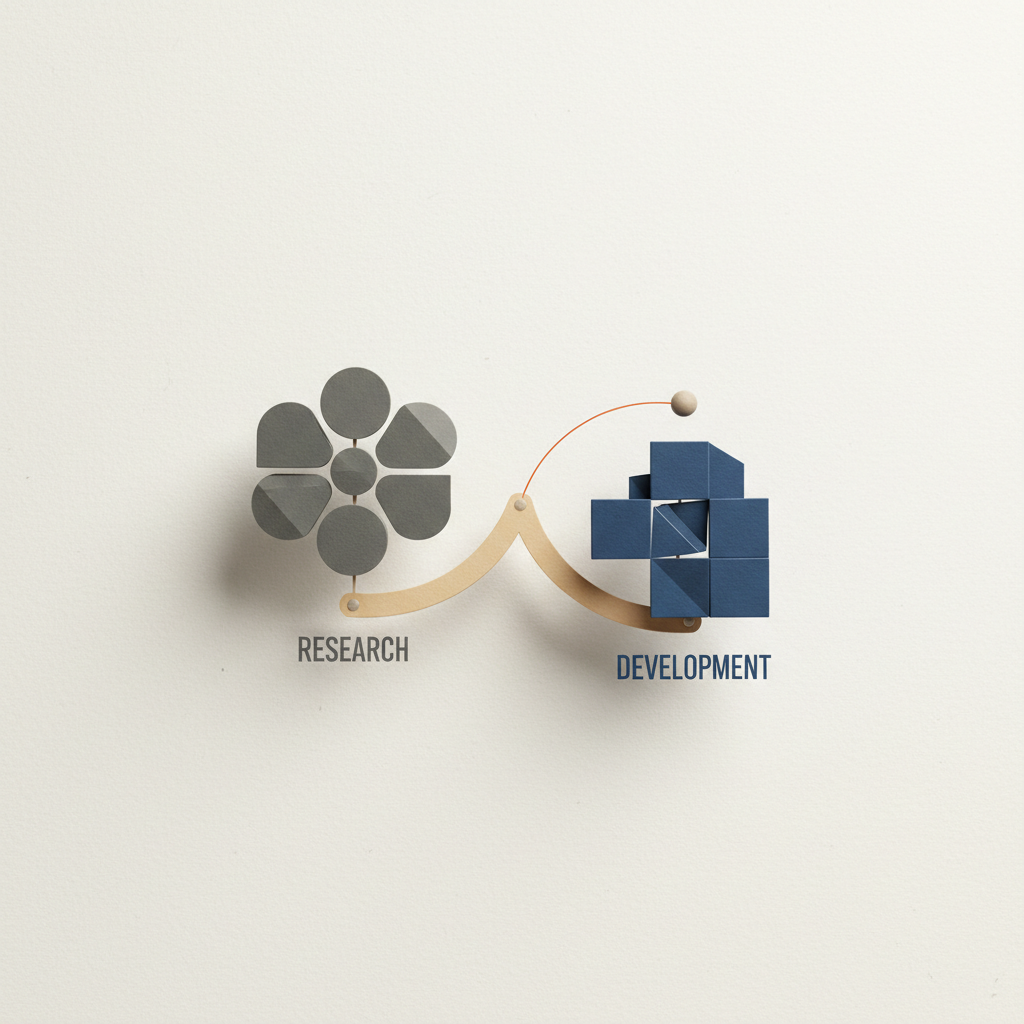
We achieve R&D balance by setting hard percentage caps on core, adjacent, and transformational investments before intake. This prevents the natural drift toward low-risk projects. By isolating funding pools, we force transformational initiatives to compete against each other rather than losing resources to incremental core improvements with easier-to-defend financial models.
Why R&D portfolios naturally drift toward safety
We observe a recurring pattern in organizations running 20 or more concurrent initiatives: the portfolio inevitably becomes a collection of safe bets. This happens because most review boards treat project approval as a series of isolated meritocratic battles. In these battles, core projects always win. They have concrete Net Present Value (NPV) calculations, predictable ROI models, and clear customer demand.
When we apply the same financial rigor to a transformational idea, we kill it before it can iterate. A project exploring a new business model cannot compete on a spreadsheet against a feature request from a top-tier client. Without pre-set caps, resource allocation devolves into a political negotiation. The loudest voices or the most certain forecasts capture the budget, leaving the organization with a portfolio that fails to meet long-term growth targets despite high efficiency in the short term.
What is the ideal ratio for core versus disruptive R&D?
We use the 70-20-10 framework as our baseline for resource allocation. This is not a suggestion; it is a structural constraint.
- 70% Core: We focus these resources on incremental improvements to existing products for known customers. This includes performance tuning, UI updates, and standard feature additions.
- 20% Adjacent: We use this pool to expand current capabilities into new markets or apply existing technology to new user groups. These projects carry more risk than core work but build on a known foundation.
- 10% Transformational: We reserve this for breakthrough technologies or entirely new business models. These initiatives have high uncertainty and a higher probability of failure but offer the highest potential for future growth.
By defining these horizons, we move the executive team from judging individual project merit to managing the aggregate risk profile of the entire portfolio.
Should maintenance work count toward our R&D portfolio balance?
We include maintenance and technical debt within the 70% core bucket. Excluding "keep the lights on" (KTLO) work creates a false sense of capacity. If we only track new feature development, we ignore the reality that engineers are often spending 30% to 50% of their time on legacy support.
Tracking maintenance within the core bucket provides true visibility. If maintenance exceeds 40% of the total R&D budget, we flag it as a strategic risk. When legacy support cannibalizes innovation capacity, we must either increase the total budget or aggressively sunset underperforming products to free up space for the 20% and 10% buckets.
Enforcing the funding firewall between horizons
We establish distinct funding pools so transformational projects never compete with core features for the same dollar. Intake is gated by bucket availability. If the core bucket is full, a new core idea must either wait for the next cycle or displace an existing core project. We do not allow "borrowing" from the transformational pool to hit a quarterly core milestone.
We change our review criteria based on the bucket:
- Core: Evaluated on ROI, margin contribution, and churn reduction.
- Adjacent: Evaluated on market fit, customer acquisition cost, and competitive positioning.
- Transformational: Evaluated through discovery-driven planning. We reward learning milestones and technical feasibility rather than immediate revenue.
How do we categorize projects that serve multiple business units?
We categorize based on the primary strategic intent rather than the funding source or the specific team doing the work. Shared platform work is a common source of confusion. We classify it as core if the primary goal is improving current delivery or reducing cost. We classify it as adjacent if the platform work is the prerequisite for entering a new market.
We avoid splitting a single project across multiple buckets. This maintains clear accountability for the primary outcome. If a project contains both core and transformational elements, we classify it by its highest-risk component. This ensures it receives the appropriate level of oversight and is not prematurely judged by core financial metrics.
How do we rebalance a portfolio after a budget cut?
When resources contract, the instinct is to cut the 10% transformational bucket first because it has the least impact on this year's revenue. We resist this. Cutting the future to save the present leads to long-term stagnation.
Instead, we apply cuts proportionally across all three buckets to maintain the strategic risk profile. We use the cut as a forcing function to kill the bottom 20% of projects within each specific bucket. Once the cuts are made, we re-baseline immediately. We ensure the remaining initiatives have full headcount support rather than asking every team to "do more with less," which typically results in all projects slowing down.
How often should we review our portfolio mix targets?
We perform a deep-dive mix review quarterly. An annual review is too slow to respond to market shifts or competitive threats. During these quarterly sessions, we look for "scope creep," where core projects attempt to masquerade as adjacent to secure funding.
Monthly operational reviews are used to check project health, but the quarterly review is where we adjust the 70-20-10 ratios. If a major initiative in the transformational bucket hits a significant technical wall, we trigger an out-of-cycle review to decide whether to reallocate that 10% to other transformational bets or move it back to the core.
The Portfolio Balance Playbook
| Action Item | Responsibility | Frequency | | :--- | :--- | :--- | | Define Buckets | Head of R&D | Annual | | Set Percentage Caps | C-Suite / COO | Annual | | Audit Active Work | Program Leads | Quarterly | | Assign Bucket Owners | Head of R&D | Permanent | | Verify Metric Alignment | Finance / Ops | Monthly |
- Define your buckets: Document exactly what qualifies as core, adjacent, and transformational for your specific industry.
- Set the caps: Agree on the percentage split with the executive team before the next planning cycle begins.
- Audit current work: Categorize all 20+ active initiatives into the new buckets to identify immediate imbalances.
- Separate the metrics: Assign ROI targets to core work and learning-based milestones to transformational work.
- Appoint bucket owners: Assign specific leads to defend the integrity of each funding pool during intake.
Honest Tradeoffs
While hard caps prevent the erosion of long-term R&D, they introduce rigidity. Internal venture capital models or metered funding approaches often provide better agility for bottom-up ideas. These alternative models allow teams to bypass top-down caps when a high-signal market opportunity emerges unexpectedly mid-cycle. By contrast, a strict bucket system might force a breakthrough idea to wait six months for the next planning cycle if its specific category is already at capacity.
In one breath
We stop approving projects in isolation by enforcing pre-set funding caps across core, adjacent, and transformational horizons. This shift requires distinct evaluation metrics for each bucket and a refusal to let short-term core needs cannibalize long-term bets. Success depends on the COO and Head of R&D defending these firewalls during every intake cycle.